Skip to content

Travel across the solar system and visit all eight planets on a journey through space!

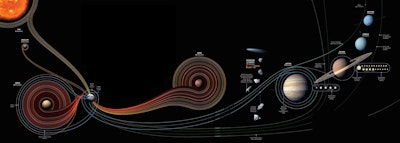
Course map

Use this journey to visualize collective, individual, or team progress. Set any goal and MoveZenGo scales the route to match it.

Included milestones

Participants unlock these milestone badges during the challenge. Each milestone can trigger a personalized email with more information about the location.

Mercury

Mercury is the smallest planet in the Solar System and the closest to the Sun. Its orbit around the Sun takes 87.97 Earth days, the shortest of all the Sun's planets. It is named after the Roman god Mercurius (Mercury), god of commerce, messenger of the gods, and mediator between gods and mortals, corresponding to the Greek god Hermes (Ἑρμῆς). Like Venus, Mercury orbits the Sun within Earth's orbit as an inferior planet; its apparent distance from the Sun as viewed from Earth never exceeds 28°. This proximity to the Sun means the planet can only be seen near the western horizon after sunset or the eastern horizon before sunrise, usually in twilight. At this time, it may appear as a bright star-like object, but is more difficult to observe than Venus. From Earth, the planet telescopically displays the complete range of phases, similar to Venus and the Moon, which recurs over its synodic period of approximately 116 days. Due to its synodic proximity to Earth, Mercury is most often the closest planet to Earth, with Venus periodically taking this role. Image by NASA/Johns Hopkins University Applied Physics Laboratory/Arizona State University/Carnegie Institution of Washington - https://photojournal.jpl.nasa.gov/catalog/PIA11364, Public Domain, https://commons.wikimedia.org/w/index.php?curid=83618472
Venus

Venus is the second planet from the Sun. It is sometimes called Earth's "sister" or "twin" planet as it is almost as large and has a similar composition. As an interior planet to Earth, Venus (like Mercury) appears in Earth's sky never far from the Sun, either as morning star or evening star. Aside from the Sun and Moon, Venus is the brightest natural object in Earth's sky, capable of casting visible shadows on Earth in dark conditions and being visible to the naked eye in broad daylight. Image by NASA/Johns Hopkins University Applied Physics Laboratory/Carnegie Institution of Washington - http://photojournal.jpl.nasa.gov/catalog/PIA10124, Public Domain, https://commons.wikimedia.org/w/index.php?curid=2450357

Earth

Earth is the third planet from the Sun and the only place known in the universe where life has originated and found habitability. While large volumes of water can be found throughout the Solar System, only Earth sustains liquid surface water. Liquid water makes most of Earth's surface, with 70.8% of Earth's surface area taken by ocean, making Earth an ocean world with extensive ice covers currently around Earth's polar regions. Land, consisting of continents and islands, takes up 29.2% of Earth's surface area, with vegitation covering it widely and its polar ice cover dwarfing its lakes and rivers. Earth's surface rests on its crust of several slowly moving tectonic plates, which interact to produce mountain ranges, volcanoes, and earthquakes. Earth's liquid outer core generates the magnetic field that shapes the magnetosphere of Earth, deflecting destructive solar winds. Image by NASA/Apollo 17 crew; taken by either Harrison Schmitt or Ron Evans - http://tothemoon.ser.asu.edu/gallery/Apollo/17/Hasselblad%20500EL%2070%20mm https://www.flickr.com/photos/projectapolloarchive/21081863984/, Public Domain, https://commons.wikimedia.org/w/index.php?curid=114976945

Mars

Mars is the fourth planet from the Sun and the second-smallest planet in the Solar System, larger only than Mercury. In the English language, Mars is named for the Roman god of war. Mars is a terrestrial planet with a thin atmosphere and has a crust primarily composed of elements similar to Earth's crust, as well as a core made of iron and nickel. Mars has surface features such as impact craters, valleys, dunes, and polar ice caps. Mars has two small, irregularly shaped moons, Phobos and Deimos. Image by Justin Cowart - Tharsis and Valles Marineris - Mars Orbiter Mission, CC BY 2.0, https://commons.wikimedia.org/w/index.php?curid=71790570

Jupiter

Jupiter is the fifth planet from the Sun and the largest in the Solar System. It is a gas giant with a mass more than two and a half times that of all the other planets in the Solar System combined, and slightly less than one one-thousandth the mass of the Sun. Jupiter is the third brightest natural object in the Earth's night sky after the Moon and Venus, and it has been observed since prehistoric times. It was named after Jupiter, the chief deity of ancient Roman religion. Image by NASA/Johns Hopkins University Applied Physics Laboratory/Southwest Research Institute - National Aeronautics and Space Administration, Public Domain, https://commons.wikimedia.org/w/index.php?curid=38515359

Saturn

Saturn is the sixth planet from the Sun and the second-largest in the Solar System, after Jupiter. It is a gas giant with an average radius of about nine and a half times that of Earth. It has only one-eighth the average density of Earth, but is over 95 times more massive. Image by NASA / JPL / Space Science Institute - http://www.ciclops.org/view/5155/Saturn-Four-Years-On http://www.nasa.gov/images/content/365640main_PIA11141_full.jpg http://photojournal.jpl.nasa.gov/catalog/PIA11141, Public Domain, https://commons.wikimedia.org/w/index.php?curid=7228953

Uranus

Uranus is the seventh planet from the Sun. It is named after Greek sky deity Uranus (Caelus), who in Greek mythology is the father of Cronus (Saturn), a grandfather of Zeus (Jupiter) and great-grandfather of Ares (Mars). Uranus has the third-largest planetary radius and fourth-largest planetary mass in the Solar System. The planet is similar in composition to Neptune, and both have bulk chemical compositions which differ from those of the other two giant planets, Jupiter and Saturn (the gas giants). For this reason, scientists often distinguish Uranus and Neptune as "ice giants". Image by NASA - http://photojournal.jpl.nasa.gov/catalog/PIA18182, Public Domain, https://commons.wikimedia.org/w/index.php?curid=121128532

Neptune

Neptune is the eighth planet from the Sun and the farthest known planet in the Solar System. It is the fourth-largest planet in the Solar System by diameter, the third-most-massive planet, and the densest giant planet. It is 17 times the mass of Earth, and slightly more massive than its near-twin Uranus. Neptune is denser and physically smaller than Uranus because its greater mass causes more gravitational compression of its atmosphere. Being composed primarily of gases and liquids, it has no well-defined solid surface. The planet orbits the Sun once every 164.8 years at an average distance of 30.1 astronomical units (4.5 billion kilometres; 2.8 billion miles). It is named after the Roman god of the sea and has the astronomical symbol ♆, representing Neptune's trident.[ Image by Justin Cowart - https://www.flickr.com/photos/132160802@N06/29347980845/, Public Domain, https://commons.wikimedia.org/w/index.php?curid=82476611

Go live today

Create your personalized fitness challenge within minutes.